2.2  The Settings Tab

You use the Settings tab of the Bookmarkshelf window to configure its behavior.

Like the Bookmarks Content, these behavioral settings are part of the Bookmarkshelf’s data, and respond to Undo, Redo, etc.

The Settings tab is organized into six sub-tabs, each of which is described in this page.

       Topics on this Page

2.2.1  General

The “Advanced” tabs are only available if you have checked on Advanced Settings in the General tab.

Show Advanced Settings

Checking this box exposes the last three subtabs, Clients, Structure and Agents, and replaces the simple Client and Agent settings in the General tab with the Tag Delimiter setting.  In general, you need this if your purpose is Usage Style 2, and may have an occasional need for it if employing Usage Style 3.

You need to adjust these advanced settings if any of the following is true for a Bookmarkshelf

This box may only be un-checked if the Bookmarkshelf is currently set to do one of the above items.  If it is, a tooltip will explain the reason.

Client Selection

If you are not using Advanced Settings, you simply select a single Client in this popup, which shows all of the supported Clients available on your Macintosh account.  If you wish to Import from or Export to more than one Client, check ON Show Advanced Settings and use the Clients tab.

Ignore duplicates in different top-level Hard Folders

This control is one way in which you can allow certain duplicate bookmarks to exist without being reported as such.

Tag Delimiter

A Tag Delimiter is the character that you type when you are typing in tags to signal the end of one tag and the beginning of another tag.  Note that the Tag Delimiter can therefore not be used within a tag.  The setting in this pane is the setting for this document, but note that there is also a “default default” Tag Delimiter set in the Preferences window.

Browser to use when visiting bookmarks

Here, you set the browser that is used when you command BookMacster to Visit a bookmark.

Description

At the bottom, this is a text field into which you can type whatever notes might help you in working with this Bookmarkshelf.

2.2.2  Open/Save

Open after BookMacster launches

Open this document after BookMacster launches is probably what you want if you intend to keep all of your bookmarks content in a single Bookmarkshelf.

Mirror-Open

If this box is checked, the document will Import from its Import Clients immediately upon opening.  This is useful if you would like to keep the document in sync with its Import Clients, without having to remember to Import whenever you open it.

Sort

You can set a Bookmarkshelf to perform a Sort operation immediately upon opening.

Find Duplicates

You can set a Bookmarkshelf to perform a Find Duplicates operation immediately upon opening.

Overriding Settings

In troubleshooting situations, the above settings can be overridden by using one of BookMacster’s secret tricks.

Mirror-Save

If this box is checked, the document will display a sheet prior to saving, giving you a default option to Export to the active Export Clients first.  This is useful if you would like to keep the Export Clients in sync with the document, without having to remember to Export.  Mirror-Save only affects Save operations that are commanded manually.  Save As operations, Save As Move operations, and Save commands executed by an Agent Worker or AppleScript command will simply Save and not Export.

2.2.3  Sorting

In the Sorting tab, you configure how sorting should be done, whenever sorting is done.  This tab is not for configuring when sorting is done, nor for initiating a sort manually.  (The latter is done simply by clicking in the menu DocumentSort All).

2.2.4  Clients

The Clients tab is only visible if you have switched on the Show Advanced Settings option.  In this tab, you set what will happen when you execute an Import or Export command.  Most importantly, you list the clients whose content will be imported from during an Import and exported to during an Export.  In each case, there are a number of options configuring how to handle the details.

Starting at the left is a checkbox which can be unchecked if you wish to temporarily disable Import or Export from a certain client.

Next is a popup menu in which you select the desired Client.  Clients found on your Macintosh account are listed explicitly.  Otherwise, you can click one of the “special” menu items:

After clicking one of these special items, appropriate dialogs will appear for navigation, account or application identification, and/or authentication as required.

Warning to power users: Do not use the Choose File advanced feature if you simply want to access the bookmarks of a locally-installed app.  Doing so will make browser-related triggers unavailable and bypass the checks against a running browser when later executing an Import or Export.  To set your Safari bookmarks as a Client, for example, simply click “Safari” in the popup menu.

Other Settings.  The rows in the Import and Export tables also have checkboxes and popups for setting the Safe Limit, Fabricate Folders, Fabricate Tags, , Merge Items, Share New Items, Special Mapping and Default Parent attributes of your Import and Export.

2.2.5  Structure

The Structure tab is only visible if you have switched on the Show Advanced Settings option.  In this tab, you define the Structure of your Bookmarkshelf.

Configure this document’s structure automatically… is the easiest to do but the more difficult to explain how it works.

If there is only one Import Client the answer is trivial – simply structure the Bookmarkshelf to match that of the browser app of this client.

But in the general case of differently-structured Import and Export Clients, it’s more complicated.  There are two possible solutions to the problem.  The first solution is to structure the Bookmarkshelf so that it can directly map any item that any Import Client can throw at it.  The second, potentially more restrictive solution, would be to require that the Bookmarkshelf be structured so that anything that the Bookmarkshelf can throw out can be directly mapped, where thrown, by all Export Clients.

BookMacster uses the first solution, which also requires that, during Export, content items which were imported into locations at which they are not allowed in the Export Client, or were moved manually to such locations, must be re-mapped into locations where they are allowed.

Here’s what happens.  A new document begins life with a quite restrictive (but somewhat arbitrary) structure: No Hard Folders, and all bookmarks content allowed at root.  (Note that if there are no Hard Folders, you must allow everything at root.  The reason why this is somewhat arbitrary is because you could alternatively define a structure with one Hard Folder, say, a Bookmarks Bar, and then restrict items allowed at root because, anything could go into this Hard Folder.)

Whenever you add or remove an Import Client, the document hypothetically restricts itself back to this original stateand then adds any Hard Folders existing in each Import Client.  If any Hard Folders were added, the document is now free to restrict items at root, and so restricts anything that is not allowed by any of the Import Clients.

At this point, all of the Structure checkboxes you see in the window have a value.  Indeed, in the trivial case of one Import Client, the Structure of the Bookmarkshelf now simply matches that of the Import Client.

However, the restrictions thus computed are not necessarily applied to a document which already has content items in it that disobey the new automatically-generated rules.  They are “grandfathered in” at their current locaions.  Hard Folders are not deleted if they contain at least one item.

This leaves the matter of the Default Parent, the destination for imported items which are unmappable.  Actually, in the case of this automatic configuration the Default Parent will never be used, because we have contrived the checkboxes to accomodate all possible imported items.  But we must set it to something, because in case the configuration is later changed to Manual it might be needed.  The document considers all the Hard Folders that were added and chooses one which would be most appropriate.  For example, if Firefox is the single Import Client, the Default Parent is set to the Unsorted Bookmarks Hard Folder.

Configure document manually allows you to choose the structure of your Bookmarkshelf.  Reading the above description of how BookMacster does its automatic configuration should apprise you of the considerations involved.

2.2.6  Agents

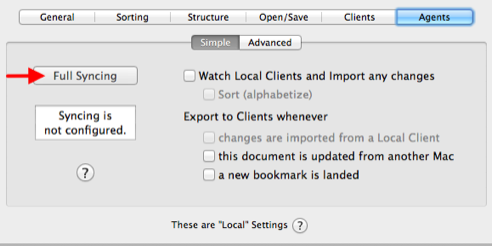
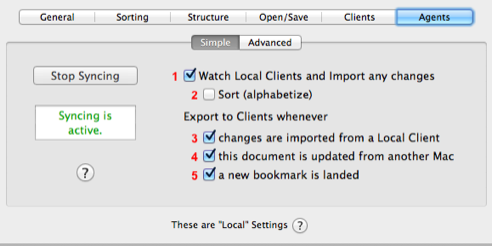
The Agents tab is only visible if you have switched on the Show Advanced Settings option.  The Agents tab is used to add, configure and delete Agents, with its Commands and Triggers.